Key planning challenges in the poultry supply chain
Poultry is one of the most efficient and fastest-growing protein value chains globally. Its relatively short production cycles, strong feed conversion, and affordability continue to drive demand across markets. Outlooks from organisations such as OECD and FAO consistently point to poultry as a primary contributor to future growth in animal protein consumption.
Yet behind this efficiency lies a planning challenge that is often underestimated.
Unlike most manufacturing industries, poultry operates as a tightly interconnected biological system, where variability is inherent. The degree of ownership and operational control during grow-out varies across regions. In some markets, notably the United States, processors retain ownership of the bird throughout its lifecycle and tightly prescribe grow-out execution. In others, including parts of Europe, ownership and decision rights may partially transfer to the farmer under regulated contracts. Regardless, this combination makes poultry supply chain management not just a forecasting exercise, but a continuous balancing act across biology, operations, regulation and market demand.
A structurally different supply chain
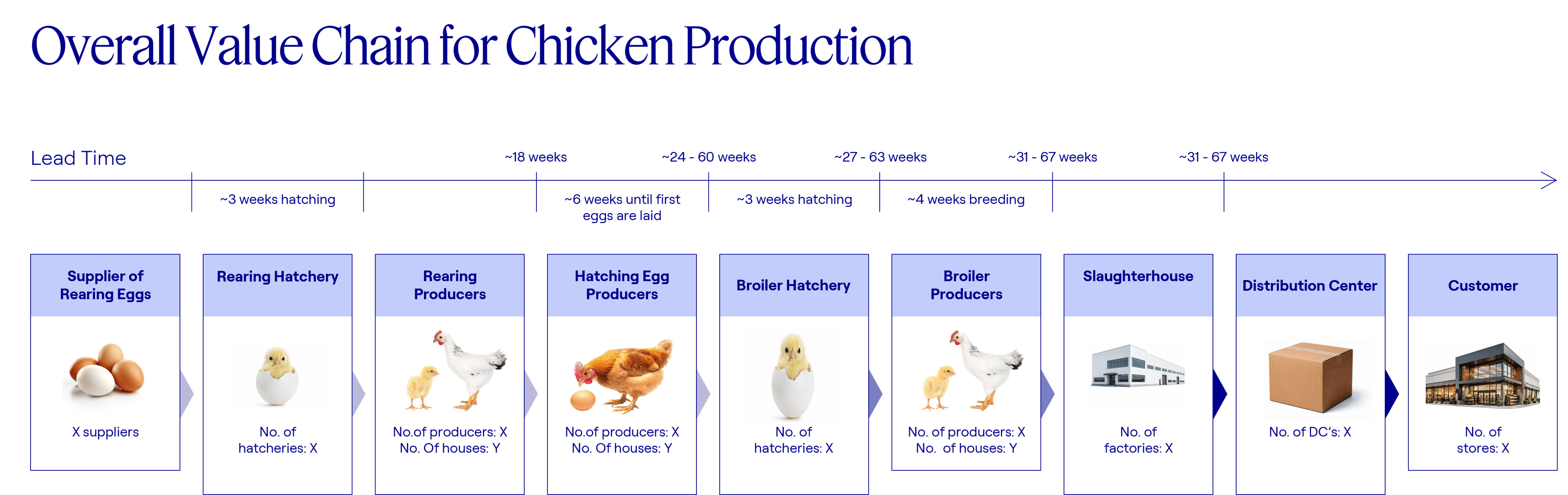
The poultry industry is frequently described as vertically integrated. In practice, it is only partially so. In most broiler operations, the processor owns or controls:
- Breeder and broiler hatcheries
- Feed production
- Transport and slaughtering facilities
- Processing and distribution
However, the grow-out stage where chicks are raised to slaughter weight is typically carried out by independent farmers operating under contract. According to the United States Department of Agriculture, the vast majority of broilers are raised under production contracts, where the processor provides chicks, feed, and veterinary support, while the grower provides housing, labour, and day-to-day flock management.
This model is operationally efficient, but it introduces a fundamental planning constraint. The processor controls upstream and downstream stages of the chain, while the grow-out transformation is executed under different degrees of company control depending on region. Regardless of the level of control over the grow-out stage, biological and external market factors have consequences.
The coordination challenge at the core of poultry planning
From a planning perspective, the grow-out stage is where the most critical uncertainties emerge:
- Growth rates vary across flocks
- Mortality and health conditions fluctuate
- Feed intake and conversion differ
- Environmental conditions impact outcomes
- Execution quality varies between farms
At the same time, downstream operations require precision. Slaughterhouses and poultry processing plants operate on tight schedules. Product specifications are strict. Customer demand is increasingly differentiated. Shelf life is limited. This creates a structural tension. The most variable part of the chain sits between two highly controlled environments.
Research into broiler supply chains consistently highlights this issue. Studies focusing on integrated planning across farms and slaughterhouses show that lack of coordination and limited visibility into flock development can lead to inefficiencies in allocation, sequencing, and plant utilisation. Variability in bird weights alone can significantly affect processing outcomes and product mix.
In other words, poultry planning is not simply about aligning supply and demand. It is about synchronising a partially controlled biological system with an industrial processing system.
Why traditional planning approaches fall short
Many planning environments in poultry are still based on assumptions that originate from discrete manufacturing. These assumptions do not translate well. Lead times are treated as fixed, even though they depend on biological development.
Supply is treated as controllable, even though it is influenced by farm-level variability. Production is treated as schedulable, even though key decisions are locked in once birds are placed. The result is often a disconnect between plan and reality.
In practice, this manifests as:
- Mismatches between expected and actual bird weights
- Suboptimal product mix at processing
- Increased waste or downgrade rates
- Reactive rescheduling in slaughter operations
- Reduced ability to meet customer specifications
These are not isolated execution issues. They are symptoms of planning models that do not fully reflect how the poultry value chain operates.
Additional layers of complexity
Beyond the structural and biological challenges, several external factors further complicate planning. Feed remains one of the largest cost drivers, and its pricing is closely tied to global commodity markets. Volatility in inputs such as corn and soybean directly affects both cost structures and, in some cases, flock performance.
Disease risk, particularly from Avian Influenza, introduces sudden and significant disruptions. Outbreaks can lead to culling, movement restrictions, and trade impacts, requiring rapid adjustments across the entire chain.
At the same time, traceability and food safety requirements continue to increase. End-to-end visibility across flocks, feed, processing batches, and finished products is no longer optional. It is a fundamental requirement for both compliance and operational control.
Together, these factors reinforce a key point. Poultry supply chain planning is not a linear process. It is a dynamic system that must continuously adapt to variability.
What better planning looks like
Leading poultry companies are not solving these challenges by focusing on a single function or tool. They are evolving how planning works across the entire chain. Extending visibility into the grow-out stage.
A critical step is improving the flow of information from contract growers into the planning process. This includes more timely and structured data on:
- Flock development and weight progression
- Mortality and health indicators
- Feed consumption
- Environmental conditions
The objective is not control, but predictability. Better visibility reduces uncertainty and enables more informed decisions upstream and downstream.
Integrating planning across stages
Planning effectiveness improves significantly when hatchery, farm, and processing plans are connected rather than managed in isolation. This means linking the following into a coherent planning model:
- Chick placements
- Expected growth curves
- Slaughter requirements
- Customer demand
Research shows that integrated approaches outperform fragmented ones, particularly when dealing with uncertainty in growth and supply. Incorporating variability into planning models. Rather than aiming for a single “correct” forecast, more advanced approaches explicitly account for variability.
Scenario-based planning, sensitivity analysis, and continuous rebalancing allow organisations to respond more effectively to deviations. This is particularly important in poultry, where small changes upstream can have disproportionate effects downstream.
Embedding traceability into operations
Traceability should not be treated as a reporting layer. Instead, it needs to be embedded into operational processes and systems, connecting:
- Flock and farm data
- Feed batches
- Processing lots
- Finished goods
This enables faster response in case of issues, but also supports better planning through improved data quality and transparency.
The role of supply chain planning systems
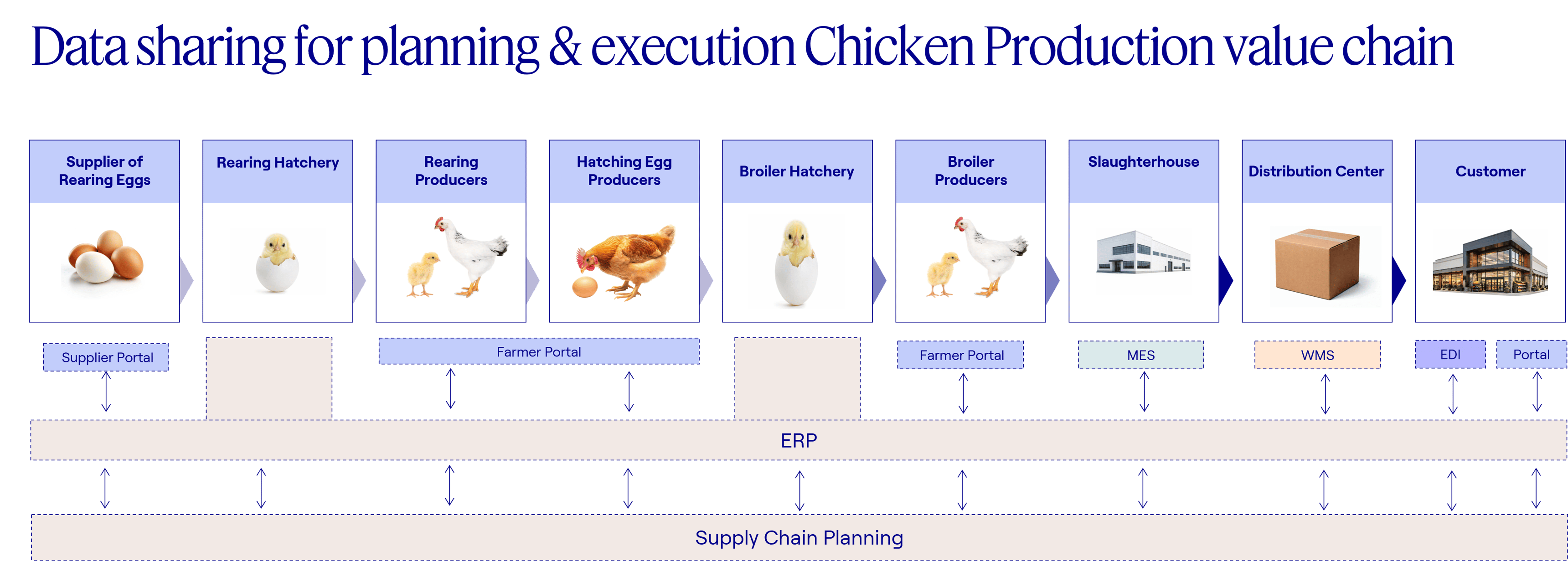
Technology plays a central role, but only when aligned with the realities of the industry. ERP systems provide the transactional backbone. They manage orders, inventory, finance, lot tracking, and core operational data. In poultry, they are essential for maintaining control and traceability across the chain.
However, ERP alone is typically not sufficient for advanced planning needs. Supply chain planning (SCP) systems add value by enabling:
- Multi-stage planning across the value chain
- Scenario simulation under uncertainty
- Optimisation of allocation and sequencing
- Alignment between supply, capacity, and demand
The real benefit emerges when ERP and SCP are designed to work together. ERP ensures data integrity and execution control. SCP enables forward-looking decision-making. Together, they form the foundation for more responsive and resilient planning.
Concluding perspective
Supply chain planning in the poultry industry is inherently complex, not because of poor practices, but because of how the industry is structured. A partially integrated model, combined with biological variability and increasing external pressures, creates a planning environment that requires more than traditional approaches.
Organisations that succeed in this space tend to share a common characteristic. They recognise that planning is not a standalone function. It is a cross-chain capability that must connect farms, feed, processing, and markets into a single, continuously adjusted system.
In that context, the role of ERP and supply chain planning is not simply to automate processes. It is to enable a more accurate representation of reality. And ultimately, better decisions.
